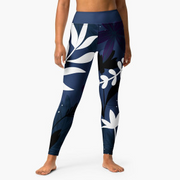
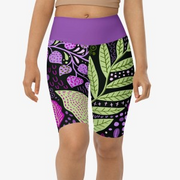
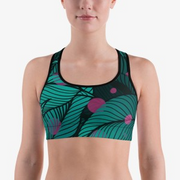
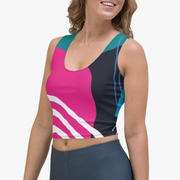
Running leggings that stay up use a wide, non-elastic waistband that sits above the iliac crest (the hip bone) and relies on compression from the fabric rather than an elastic drawstring alone. Leggings that slip down during a run do so because the waistband sits at or below the iliac crest, where the hip taper gives the fabric nowhere to anchor. This is the number one complaint in runner forums, and it has a specific, solvable cause.
Most "best running leggings" guides test comfort in the changing room. This guide tests against the mechanics of running: hip extension, stride frequency, phone-pocket security, and the 30-minute mark when sweat changes how fabric grips skin.
Shop the full Loony Legs running collection
What Makes Running Leggings Different from Regular Leggings?
Running-specific leggings are engineered for unidirectional forward motion, a heel-strike or midfoot-strike loading pattern, and continuous hip extension across 5,000 to 15,000 steps per run. The design consequences are specific: flat seams at the inner thigh to prevent friction burn at high stride count, a gusset that allows full hip extension without fabric pulling from the waistband, and moisture-wicking fabric that remains lightweight rather than saturating.
General-purpose leggings serve yoga, gym, and casual wear. They stretch in 4 directions and feel comfortable during static holds and lateral movement. But hip extension in running, specifically the backward leg drive phase, pulls the waistband down when the legging does not have enough length in the back rise. Back rise is the distance from the waistband to the crotch seam at the rear. A short back rise causes the legging to pull down with every stride.
The Loony Legs running collection uses a high back rise designed for active movement. The waistband hits above the hip crest and the back panel maintains tension through a full running stride. The fabric is 82% polyester and 18% spandex (or 74% recycled polyester and 26% elastane in the recycled range) in a 4-way stretch construction.
What to Look for in Running Leggings
What Waistband Type Stays Up During Running?
A non-roll waistband with a double-layer construction stays up during running because the added width distributes the grip load across a larger contact area. Single-layer elastic waistbands concentrate grip at a single thin line. They work in the fitting room but migrate down during a sweaty run because sweat reduces the coefficient of friction between skin and elastic.
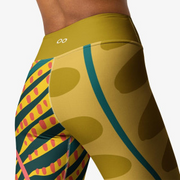
Loony Legs leggings use a double-layered waistband with a 0.25-inch (0.6 cm) internal elastic for support. The outer layer provides structure. The inner layer contacts skin and maintains grip via fabric compression rather than elastic tension alone. The difference is most noticeable after the 20-minute mark of a run when sweat becomes a factor.
When testing a waistband before purchase: fold it down completely and release. A high-quality double-layer waistband snaps back flat. An elastic-only waistband returns in a slightly rippled or rolled shape, which is the shape it will assume during your run.
Do Running Leggings Need Pockets?
Yes. A phone pocket in running leggings is not optional for safety-conscious runners. Running without a phone requires the runner to either carry a hand-held pouch (which alters arm swing mechanics) or go without (which eliminates navigation, emergency contact, and music). A built-in phone pocket that compresses the phone against the body rather than letting it swing in a loose pocket is the differentiating feature.
The leggings with pockets and plus-size leggings with pockets collections at Loony Legs include phone-size pockets in multiple designs. The Recycled Animal Printed Leggings "Animal Leaves" with Pockets and the Recycled Plus-Size Printed Leggings "Ethno Pop" with Pockets in Blue/Green both feature secure side pockets tested for phone retention during movement.
To test pocket security before a run: place your phone in the pocket and perform 20 high knees. The phone should not bounce or migrate upward out of the pocket opening.

What Fabric Is Best for Running Leggings?
An 80 to 88 percent polyester blended with 12 to 20 percent elastane provides the optimal balance of moisture-wicking speed, compression retention, and color fastness for running. Polyester moves moisture from skin to the fabric surface faster than any natural fiber, a critical feature when a 5km run generates 0.5 to 1.5 liters of sweat depending on temperature. Elastane above 12% provides enough stretch for hip extension without the fabric stretching out and losing compression over the session.
Nylon-spandex blends are a second viable option. Nylon is slightly softer against the skin and more abrasion-resistant at the inner thigh, making it a preference for runners who experience friction there. Nylon's moisture-wicking speed is slower than polyester in high-sweat conditions, which means it stays wetter longer.
How Tight Should Running Leggings Be?
Running leggings should apply consistent compression across the leg with no pressure points and no excess fabric that bunches at the knee, inner thigh, or ankle. The "two-finger test" works: slide two fingers under the waistband. It should require slight resistance. Apply the same test at the calf and quad: fabric should feel snug but not cut into the skin.
Leggings that are too tight restrict blood flow at the knee crease and reduce proprioception, the sensory feedback from foot strike that runners use to adjust form. Leggings that are too loose do not provide the compression benefit and migrate during movement.
What Length Is Best for Running Leggings?
Full-length leggings are the most versatile for year-round running because they provide UV protection on exposed legs, reduce road debris contact on trail runs, and add a thin thermal layer in temperatures below 60 degrees F. Loony Legs leggings range in inseam from 27.125 inches at XS through 29.5 inches at XL, based on the brand's published size tables. At size M the inseam is 28 inches.
Capri-length leggings are preferable above 75 degrees F because they reduce heat retention at the lower leg. Below the knee, the leg produces and dissipates heat most efficiently when ventilated. Loony Legs capris run from 18.875 inches inseam at XS through 22.875 inches at XL.
The Slip-Down Problem: Why Leggings Fall During Running
Leggings slip down during running for 3 specific reasons: insufficient back rise, an elastic-only waistband, and fabric that has lost compression through repeated washing. The slip-down is not a size problem. Women in every size experience it when these three structural issues are present.
Back rise fix: a short back rise causes the legging to pull down with every stride during the leg drive phase. A legging with a high back rise that maintains tension through hip extension resolves this.
Elastic-only waistband fix: switch to a double-layer construction. Feel the inside of the waistband. If it has a bare elastic band visible, it will roll during sweaty runs.
Fabric compression fix: replace leggings that are 2 or more years old and show visible pilling or fabric transparency. Compression elastane degrades with heat exposure (machine drying) and repeated washing. Pilling at the inner thigh is the first visual indicator.
Is It Worth Buying Bold-Print Running Leggings?
Yes. Research on pedestrian and runner conspicuity consistently shows that high-contrast, brightly-colored clothing improves driver detection compared to dark colors, particularly in low-light conditions. A review published in Safety Science confirmed that garment design and color contrast affect how readily pedestrians are spotted by approaching drivers. Bold prints with contrasting colors provide that visual distinctiveness.
Beyond safety, running in printed leggings has motivational value grounded in the Adam and Galinsky (2012) enclothed cognition research: expressive workout wear correlates with higher motivation and perceived effort tolerance. Bright, patterned running gear is functional, not just aesthetic.
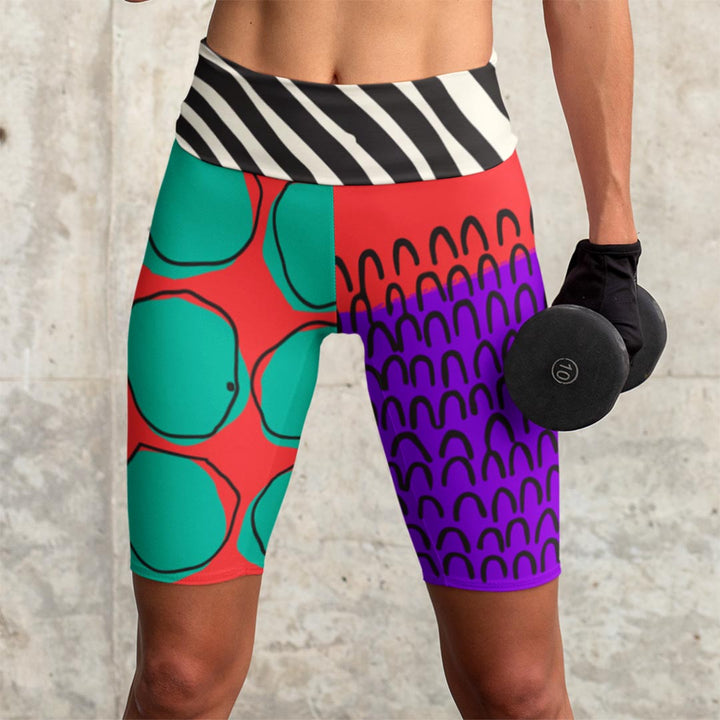
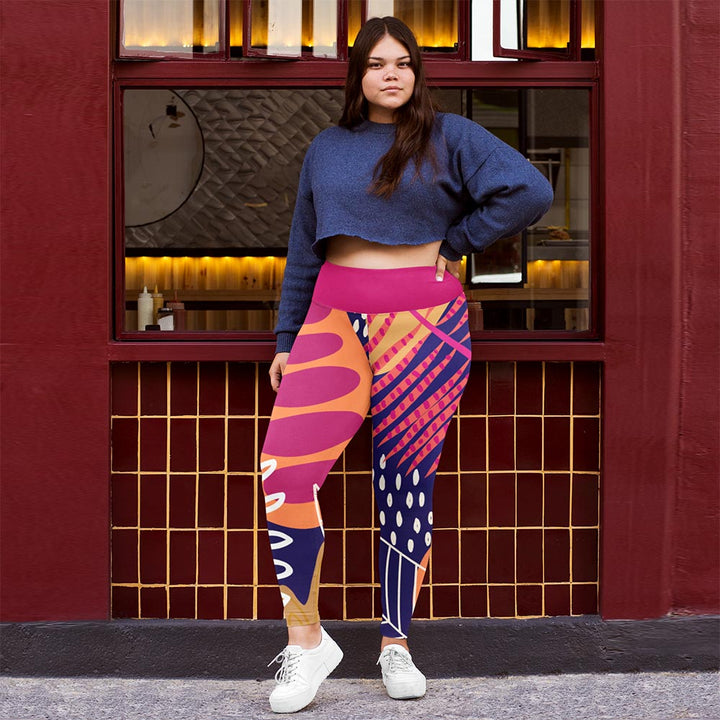
The Loony Legs running collection offers over 30 prints at $92, all with the high back rise and double-layer waistband construction suited for running. The FrankenCheetah Leggings in Blue/Teal and the CrocoZebra Leggings in Purple are two high-contrast options that maximize visibility.
What to Pair with Running Leggings
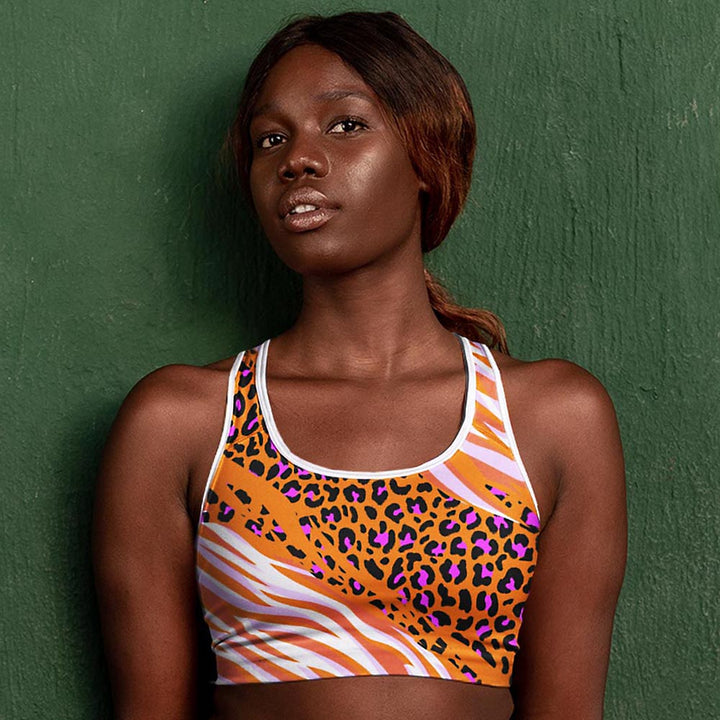
A high-impact sports bra and a fitted moisture-wicking top complete the running kit. For temperatures below 50 degrees F, add a slim-fit running jacket or long-sleeve base layer. The Loony Legs High Impact Bras at $89 coordinate with the patterned legging range. The Sage Safari High Impact Bra pairs with the Sage Safari Leggings for a full coordinated run kit.
Running socks are the final piece that affects legging performance: compression socks reduce calf fatigue on longer runs (8km and above) and keep the legging ankle from sliding up the calf, which is a minor but consistent irritation on full-length leggings.